On one side, a local currency steadily collapsing in a single direction, losing its value day by day; on the other, an alternative digital currency swinging wildly up and down without warning. Caught between these two extremes of financial chaos, a single tool has emerged to reconcile them: crypto cards.
In this article, we explain how crypto cards successfully bridge this gap, and why digital currencies alone are not enough to solve the problem.
Quick Summary (TL;DR)
In countries like Argentina, Turkey, Venezuela, Lebanon, and Nigeria, local currency collapse has pushed millions of people toward stablecoins pegged to the dollar as a parallel savings system.
Roughly 66% of the entire global stablecoin supply is now held in emerging markets, according to 2026 data. But holding a stablecoin is one thing; spending it on bread, rent, and bills is another matter entirely, since most merchants don't accept it directly.
This is exactly where crypto cards vs currency collapse closes the gap: they let you convert your stable digital balance into a card accepted anywhere Visa is accepted, without exposure to either your local currency's collapse or the volatility of unstable cryptocurrencies like Bitcoin.
What's the difference between currency-collapse volatility and crypto-market volatility?
Even though both are sometimes described with the same word, "volatility," their nature is fundamentally different, and understanding that difference is the key to this entire article.
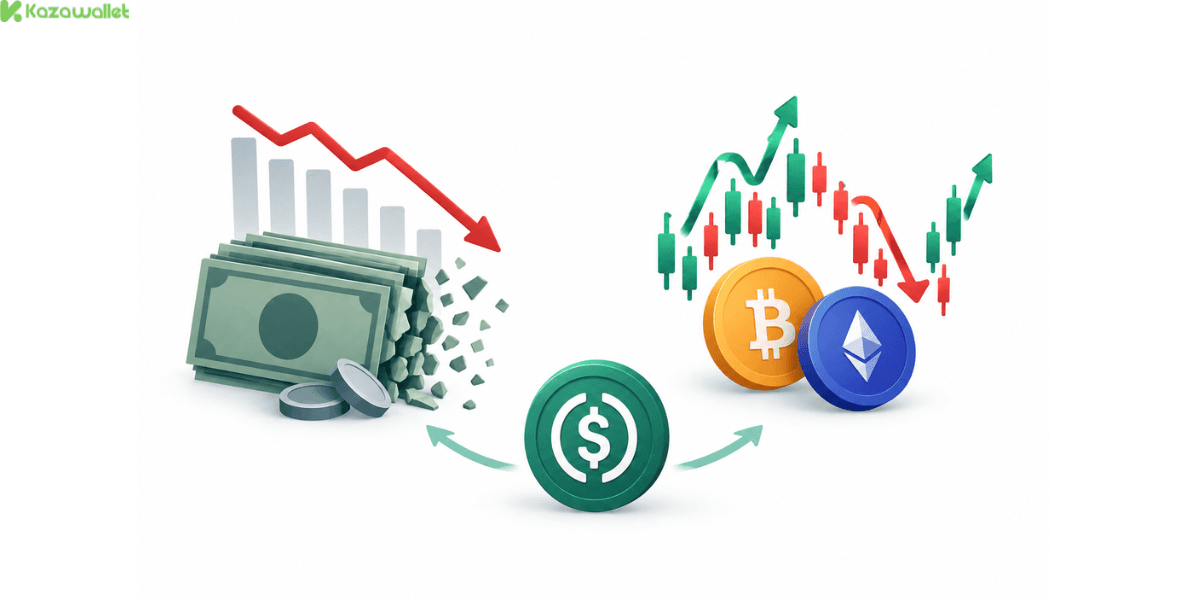
Local currency collapse is usually one-directional volatility: the currency loses value gradually or sharply, but it rarely rises back at the same pace to make up for the loss.
In Argentina, for example, the central bank projected inflation at 30.5% by the end of 2026, a massive figure even though it marks a notable improvement from rates that exceeded 100% annually back in 2023.
This kind of volatility means that every day you delay converting your savings into something more stable, you lose real purchasing power.
Crypto market volatility is entirely different: bidirectional and unpredictable. The price of a coin like Bitcoin or Ethereum might jump sharply within days, then drop by a similar amount within another few days.
Anyone who turns to these coins as an alternative to their collapsing local currency might, ironically, find they've simply traded one kind of financial uncertainty for another just as intense.
This is exactly where stablecoins come in: crypto assets pegged to the value of a stable asset like the US dollar, such as USDT and USDC, designed to avoid that second kind of volatility entirely while offering a solution to the first.
Which countries are actually living through this collapse, and how did they respond?
Recent numbers show a clear, repeating pattern: the more severe a local currency crisis gets, the more the population turns to stablecoins as a parallel safe haven.
- Argentina: stablecoin adoption among the population reached 19.8% by January 2026 according to some platform estimates, while other indices put adult adoption above 40% using different methodologies. Stablecoins accounted for more than half of peso exchange purchases in some recorded trading windows.
- Turkey: stablecoin transactions totaled roughly 3.7% of GDP in 2024 after currency controls were eased, and the share of crypto users grew from 40% to 52% over 18 months.
- Venezuela: climbed to 17th place globally in crypto trading volume in Q1 2026, at roughly $18 billion, with USDT accounting for about 90% of active peer-to-peer listings tied to the Venezuelan currency. Local merchants reported that around 40% of their income came in USDT during periods of intense political turmoil.
- Lebanon: After the banking system collapsed, per-capita crypto usage became one of the highest in the MENA region, with heavy reliance on direct peer-to-peer transfers.
- Nigeria: stablecoin reliance continues despite regulatory pressure, through informal channels like WhatsApp groups and peer-to-peer trading platforms.
Regionally, Latin America's cryptocurrency economy saw a remarkable 9.8% growth in 2026, according to a Chainalysis report, driven by a massive surge in major markets like Brazil and Venezuela.
Why aren't stablecoins alone enough to solve the problem?
This is where the practical gap shows up for anyone living this reality day to day.
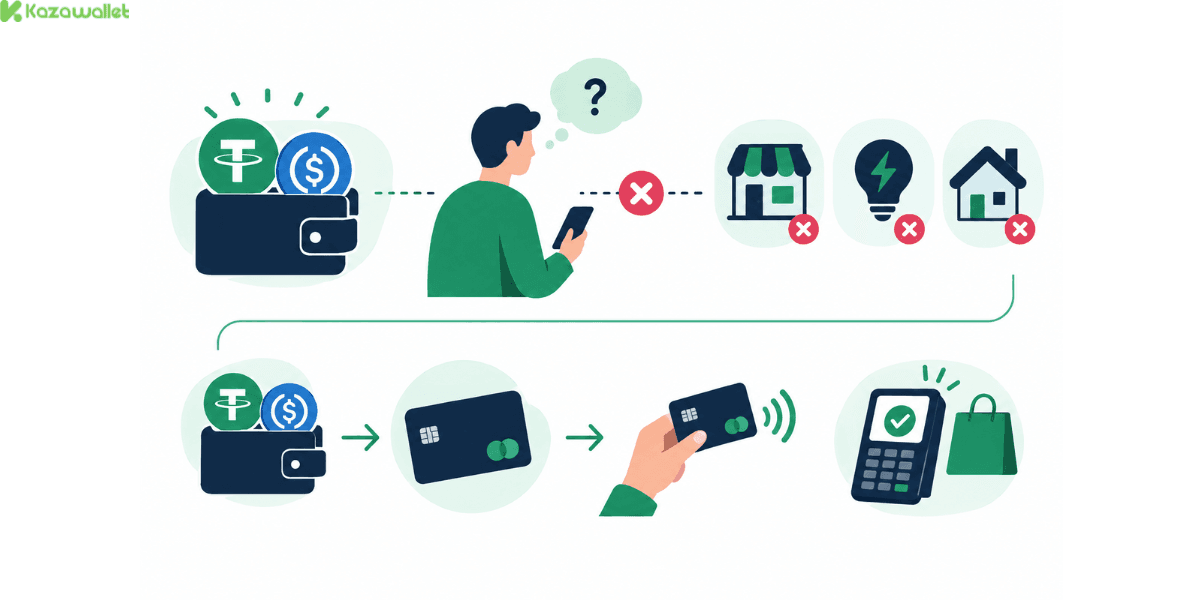
Holding a balance in USDT or USDC effectively solves the problem of hyperinflation and the erosion of purchasing power, but it doesn't solve the problem of spending money day to day.
The corner grocer, the electric company, and the landlord typically don't accept direct crypto payments, no matter how stable its value is.
That means the average person needs one more step: converting that stable balance into something they can spend at the stores and services they deal with daily, without routing it through an already-struggling local banking system, and without eating heavy conversion fees or losing time in the process.
How Do Crypto Cards Bridge the Currency Collapse Gap?

Crypto cards are designed to be the ultimate bridge between your stable digital balance and actual spending in the real world:
Real-Time Auto-Conversion at the Point of Sale
In crisis situations, you are usually forced to buy foreign or digital currency, then manually sell it and withdraw it through a bank just to cover your expenses- a slow and complex process.
Crypto cards eliminate this friction entirely.
You keep your digital balance in your wallet, and when you swipe or tap your card at a store, only the exact required amount is sold and instantly converted, in a fraction of a second, into the local currency the merchant needs to settle the transaction.
Breaking Free from Strict Banking Controls
When a currency collapses, central banks often impose harsh restrictions on withdrawing funds or transferring them abroad. Because crypto relies on decentralized networks, these cards act as a financial safety valve.
They preserve the value of your wealth away from volatile political decisions and grant you the freedom to access and spend your money globally across millions of merchants with ultimate flexibility.
Turning Stablecoins into a Virtual Dollar
To avoid the severe market swings seen with coins like Bitcoin, stablecoins (such as USDT and USDC) now account for roughly 90% of the total transaction volume on crypto cards.
In countries suffering from hyperinflation, people top up their cards with stablecoins to protect their savings from daily erosion, effectively turning the card into a virtual dollar card ready for safe, everyday purchases.
Are there risks worth knowing about with this approach?
Despite the clear benefits, it's important to present the full picture without overstating it.
The regulatory status of crypto varies significantly from country to country and keeps changing, and some governments view the spread of these tools with growing concern, especially when they're tied to circumventing official currency controls, so checking your local laws remains a necessary step before any widespread use.
Full reliance on a phone and internet connection also remains a practical weak point; a service outage could mean being unable to access your money at a critical moment.
Finally, some platforms charge conversion fees or spreads when swapping currencies, so it's always worth comparing these costs before settling on a specific tool.
How does Kazawallet combine stability with real spending power?
Everything we've discussed in this article essentially comes down to one tool: a platform that lets you move smoothly from a stable digital balance to real spending, without going through the complications of a struggling traditional banking system.
A platform like Kazawallet delivers that directly:
- Direct conversion to USDT or dollars, with no waiting periods or extra verification steps delaying your money, regardless of your local currency's condition.
- Load a virtual Visa card from your balance to spend online or in physical stores anywhere Visa is accepted, just like a regular bank card. For the full details, check out everything you need to know about the Kazawallet virtual card.
- Managing both your crypto and traditional balance in one place, giving you real flexibility to move between stable savings and instant spending depending on what you need.
That way, you're not forced to choose between absorbing your local currency's collapse or riding out unstable crypto swings, you get the safe middle ground between both.
Frequently Asked Questions
Do stablecoins fully solve the problem of local currency collapse?
They solve a large part of the problem related to preserving purchasing power, but they don't solve the problem of actual day-to-day spending, since most local merchants don't accept them directly as payment.
Why do Turkey, Argentina, Venezuela, and Lebanon use crypto differently despite facing a similar problem?
Because each country faces different economic and regulatory conditions in terms of crisis severity, how strict banking controls are, and the availability of technical infrastructure, which all shape the pattern and scale of adoption.
Are crypto cards available in every country?
This varies by platform, service provider, and local laws in each country, so it's essential to check the service's availability and terms specific to your country before relying on it.
Is holding stablecoins instead of my local currency completely safe?
Stablecoins are far less volatile than other cryptocurrencies, but they're not entirely risk-free, since they depend on the issuer and its actual commitment to maintaining the financial backing required for their value
In closing
This isn't a story about one kind of volatility; it's two parallel stories: a local currency eroding slowly or rapidly, and a cryptocurrency swinging up and down without warning.
Between these two extremes, stablecoins alone weren't enough; what was needed was a tool combining stable value with actual day-to-day spending power.
That's exactly what crypto cards are trying to deliver, and it explains why they're spreading so quickly in every country where people live with this double kind of financial uncertainty