
You open a Telegram group or an X account talking about crypto, and you run into lines like "diamond hands are holding, paper hands are folding, and the bagholders are crying on the peak they were standing on yesterday."
You feel like you've walked into the middle of a conversation in a completely different language, even though every single word is technically English.
That language didn't come out of nowhere. It was shaped over years by real experiences an entire community lived through: sudden gains, painful losses, and scams that taught plenty of people hard lessons.
In this guide, we decode the most essential crypto slang one by one, in plain language, so you can actually understand what's going on around you instead of feeling lost.
Quick Summary (TLDR)
Crypto slang falls into two broad categories: descriptive terms that explain market behavior, like HODL (holding an asset despite volatility) and FOMO (buying out of fear of missing a rally), and warning terms you should immediately pay attention to, like rug pull (a scam where developers vanish with investors' money) and FUD (spreading scary rumors to push people into panic selling).
Knowing the difference between the two matters far more than memorizing every single word, because some of these exact terms are what scammers use to manipulate newcomers.
Where Did This Strange Crypto Slang Even Come From?
Most of these terms were born in forums and trader chat groups, then spread until they became a permanent part of the culture.
The most famous example is the word HODL itself. On December 18, 2013, a user on the Bitcointalk forum posted a message titled "I AM HODLING," while Bitcoin's price was crashing hard at the time.
He meant to type "hold," but misspelled it, reportedly while drinking, and never bothered to fix it. The typo stuck, shaping the modern HODL meaning as "Hold On for Dear Life." More than ten years later, it's still the first crypto word almost everyone learns.
That story sums up how most crypto slang comes to exist: a random moment, a joke, or even a typo, that eventually becomes a core part of an entire community's language.
The basic terms you'll run into every single day
These few terms alone cover most everyday conversations about crypto:
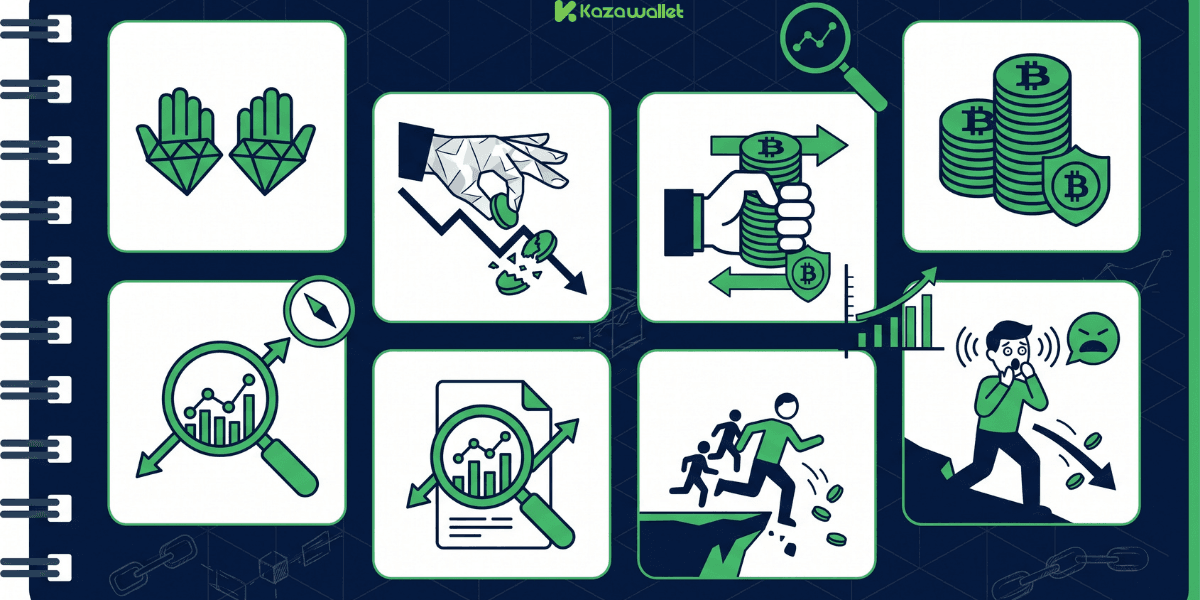
HODL: Holding onto your coins and refusing to sell even when the price drops, out of confidence it'll go back up.
FOMO (Fear Of Missing Out): buying a coin just because its price is rising fast, not because you actually researched or analyzed it.
Diamond Hands and Paper Hands: two terms describing how someone handles the psychological pressure of price swings. "Diamond hands" hold firm no matter how badly the price crashes, confident things will recover. "Paper hands" sell at the first small dip, driven by fear.
FUD (Fear, Uncertainty, and Doubt): spreading negative news or rumors, whether true or made up, to push people into panic selling. Sometimes "FUD" really is a fake rumor, but sometimes it's a legitimate warning being dismissed just because it's negative, so don't automatically assume every bad headline is a lie.
DYOR (Do Your Own Research): a reminder that any opinion posted in a group or on social media isn't reliable financial advice, and that you need to verify things yourself before making any decision.
ATH (All-Time High): the highest price a given coin has ever reached.
Terms that describe overall market movement
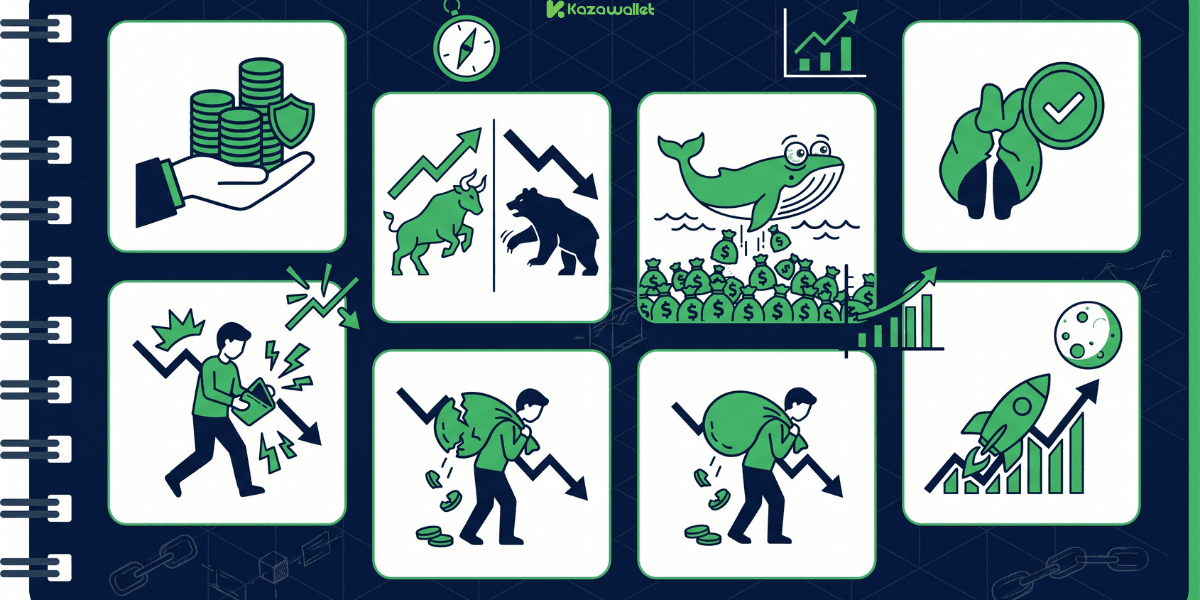
Whenever people talk about the direction of the market itself, you'll hear this standard crypto vocabulary constantly:
Bull Market and Bear Market: a bull market describes a general period of rising prices, while a bear market describes an extended period of falling prices. (Think of a bull thrusting its horns upward, versus a bear swiping its claws downward.)
Whales: a person or entity holding a large enough amount of a coin to noticeably move its price when they buy or sell in one go.
Rekt: describes someone taking a major loss, usually from a risky trade or falling for a scam.
Bagholder: a sarcastic term for someone who bought a coin near its peak, watched the price crash, and kept holding on anyway, hoping it'll bounce back to where it was.
DCA (Dollar-Cost Averaging): a strategy of buying a small, fixed amount of a coin regularly, say weekly or monthly, instead of trying to buy a large amount all at once at the "perfect" moment.
Mooning: informal slang describing a fast, sharp jump in a coin's price.
Terms that should make you pause and take notice
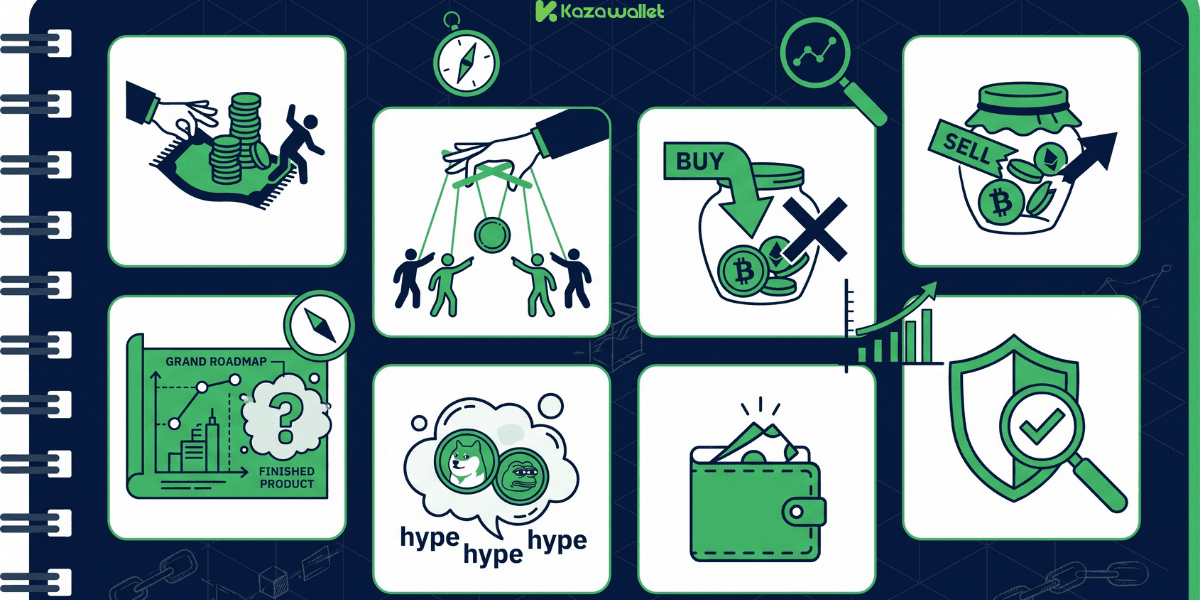
This group is different from the rest, because these aren't just descriptions of market behavior, they're warnings directly tied to protecting your money:
Rug Pull: a type of scam where a project's team collects money from investors, then suddenly disappears with it, without warning. According to estimates from 2025, losses from this type of scam alone topped $2.8 billion globally, and some analyses suggest close to 62% of new meme coins get flagged as a potential scam of this kind within their first month.
Shilling: aggressively and repeatedly promoting a coin, often by someone with a direct financial stake in its price going up, without clearly disclosing that stake.
Honeypot: a type of smart contract designed so you can buy the coin easily, but it's impossible to sell it later, leaving your money trapped inside the contract with no way out.
Vaporware: a project that makes big promises and ambitious roadmaps, but never actually ships a working product.
Memecoins: coins created essentially as a joke, often named after a dog or a popular internet frog, with no real technical project behind them. Their value depends entirely on community hype and waves of FOMO, making them one of the riskiest categories of crypto assets, and among the most likely to end in a rug pull, as mentioned above.
The practical rule here is simple: whenever you encounter this side of crypto slang, treat it as a signal to be extra careful, not just another buzzword passing through the conversation.
Community and greeting terms
Part of this language is purely social, containing popular crypto acronyms with no direct connection to trading:
GM and GN: short for "good morning" and "good night," an almost daily greeting across crypto communities on social media.
WAGMI (We're All Gonna Make It): an expression of collective optimism and mutual support among members of a community, especially during rough patches.
NGMI (Not Gonna Make It): the opposite of WAGMI, used sarcastically to describe someone who clearly made a bad call, like selling a coin right before it rallied.
Degen: short for "degenerate," it went from an insult to a near badge of pride, describing someone who takes on a lot of risk in their trades without much hesitation.
IYKYK (If You Know, You Know): used to point at an inside joke or piece of information only understood by people within a specific community.
Technical terms you'll need once you actually start using crypto
Once you move from reading about crypto to actually using it, you'll run into these technical terms specifically:
Gas Fees: the fee you pay to process a transaction on a given blockchain network, which changes depending on how congested the network is at that moment.
Staking: locking up a certain amount of a coin for a period of time in exchange for a regular return, instead of leaving it sitting idle in your wallet.
Airdrop: a free distribution of a new coin or token to a group of users, usually as a marketing tool to introduce a new project.
CEX and DEX (Centralized and Decentralized Exchanges): a CEX is run by a company and usually requires identity verification before you can use it. A DEX, on the other hand, is software that lets you trade directly from your own wallet, with no middleman and no ID required.
KYC (Know Your Customer): an identity verification process most licensed platforms require before letting you trade or withdraw, a regulatory requirement, not a red flag.
Sats: short for "satoshi," the smallest unit Bitcoin can be divided into.
One term on this list deserves a moment of its own, because it's directly tied to the safety of your money:
Seed Phrase: a string of 12 or 24 random words your wallet gives you when you first create it. These words are the entire root of your funds, whoever holds them owns your wallet and everything in it. If you lose them, your money is gone permanently, and there's no customer support team or company that can recover it for you.
Do you need to know all of this to use a platform like Kazawallet?
Here's the good news: you don't need to memorize an entire dictionary of slang to start managing your digital money confidently.
A platform like Kazawallet is built to be clear and straightforward, without the complexity you might run into in some trading communities:
Buy coins like Bitcoin and Ethereum directly, in simple, understandable steps, with no need to understand advanced trading terminology.
A clear, up-to-date balance at all times, instead of guessing what's happening in the market from conversations packed with jargon.
Direct conversion to USDT or dollars and withdrawal, or loading a virtual Visa card, with no waiting periods or extra verification steps holding up your money.
That way, you can pick up this language gradually, on your own time, without needing to master it first just to manage your money safely and clearly from day one.
Frequently Asked Questions (FAQ)
Do I need to memorize all these terms before I start using cryptocurrencies?
No, but knowing the difference between everyday descriptive terms and warning signs, such as rug pull, shilling, and honeypot—is genuinely useful for protecting yourself against scams.
Does "FUD" always mean the news is fake?
No. Sometimes the term describes an actual false rumor, but other times promoters of a project use it to dismiss a legitimate, well-founded warning simply because it is negative. Never automatically assume that every piece of negative news is just noise.
What is the difference between HODL and DCA?
HODL means holding onto what you own and not selling despite price swings, whereas DCA (Dollar-Cost Averaging) is a buying strategy based on investing fixed, smaller amounts on a regular schedule, regardless of whether the price is up or down at that moment.
Why do some platforms require me to complete KYC?
Because it is a standard compliance procedure mandated by regulatory authorities for licensed platforms. It verifies users' identities to curb illicit activity and is an indicator that the platform operates within a clear regulatory framework, rather than a red flag in itself.
In closing
Crypto slang can feel overwhelming at first, but at its core it's just a set of shorthand terms born out of real experiences an entire community lived through over the years.
Some of it is playful and descriptive, some of it is a serious warning worth your full attention.
The important thing to remember is that understanding this language comes gradually with time, and using your digital money safely and effectively doesn't have to wait until you've mastered it completely