In 2019, the European Union passed a regulation requiring card providers to display the currency conversion cost as a percentage mark-up over a reference rate issued by the European Central Bank.
Why was a law needed? Because for years, this cost was hidden within the exchange rate itself, not in a line item labeled as a fee. This is just one of the places where a card's cost hides, making card fee items harder to understand than they appear.
In this article, we calmly decode the language of fees without pointing fingers: what card fee items your card might contain, where the actual cost hides, what the phrase "no fees" really means, and how to read the fee schedule before you sign.
Quick Summary (TL;DR)
Card fee items are distributed across multiple parties and under multiple names: issuance, maintenance, top-up, withdrawal, and inactivity fees, plus a cost that doesn't even carry the name of a fee, the spread between the real exchange rate and the rate applied to you.
The ambiguity often centers around currency conversion and accepting the offer to pay in your home currency, known as Dynamic Currency Conversion (DCC), which reports say can add a higher margin than standard conversion.
The phrase "no fees" might mean the absence of an advertised fee, but it doesn't necessarily eliminate the price spread or the network fees when topping up with cryptocurrency.
So request the full fee schedule, ask about the applicable exchange rate and its reference, pay in the local currency, and compare your actual spending cost rather than a single advertised percentage.
Why Do Bank and Crypto Card Fees Seem Complex or Hidden?
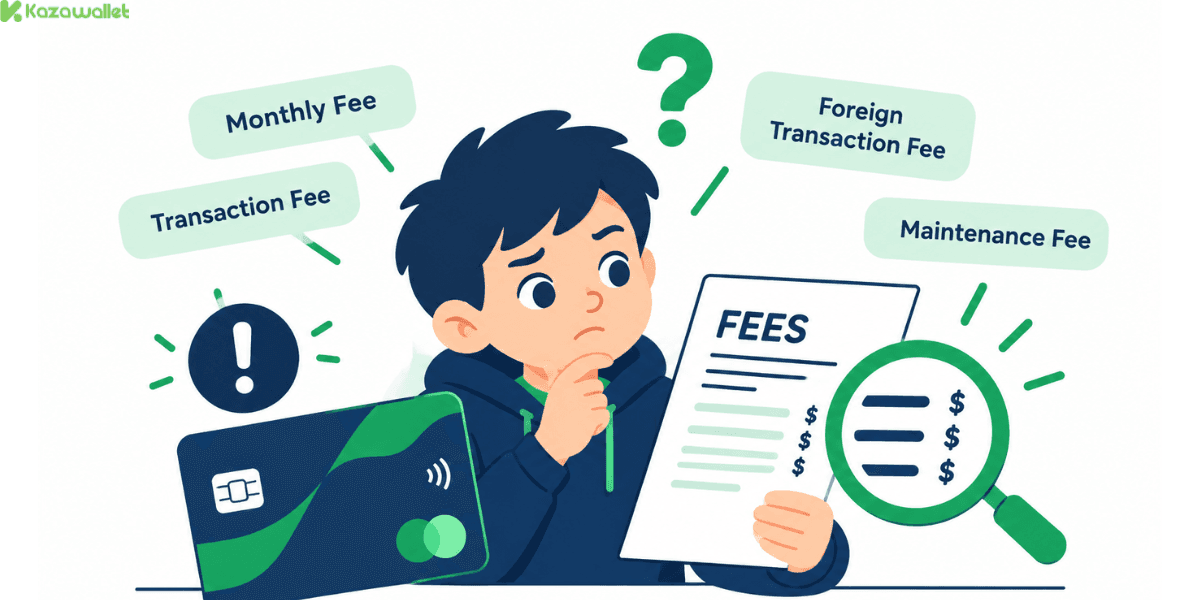
The main problem with card fee items isn't always that they are hidden, but rather that they are distributed and phrased in ways that make adding them up difficult:
Flexible phrasing: Phrases like "up to 3%", "starting from", "fees may apply", or "according to the applicable exchange rate" do not give you a final number.
Multiple parties: A fee might be charged by the card network, the issuer, the merchant, the conversion provider, and the blockchain network if you top up with crypto.
A cost without a fee name: The spread between the real rate and the applied rate does not appear as a separate line item.
Multiple types: Some industry guides mention that a crypto card might impose up to eight types of fees, varying from one provider to another.
This doesn't mean every provider is hiding something; it just means you need to know where to look.
What Are the Main Card Fee Items Deducted From Your Balance?
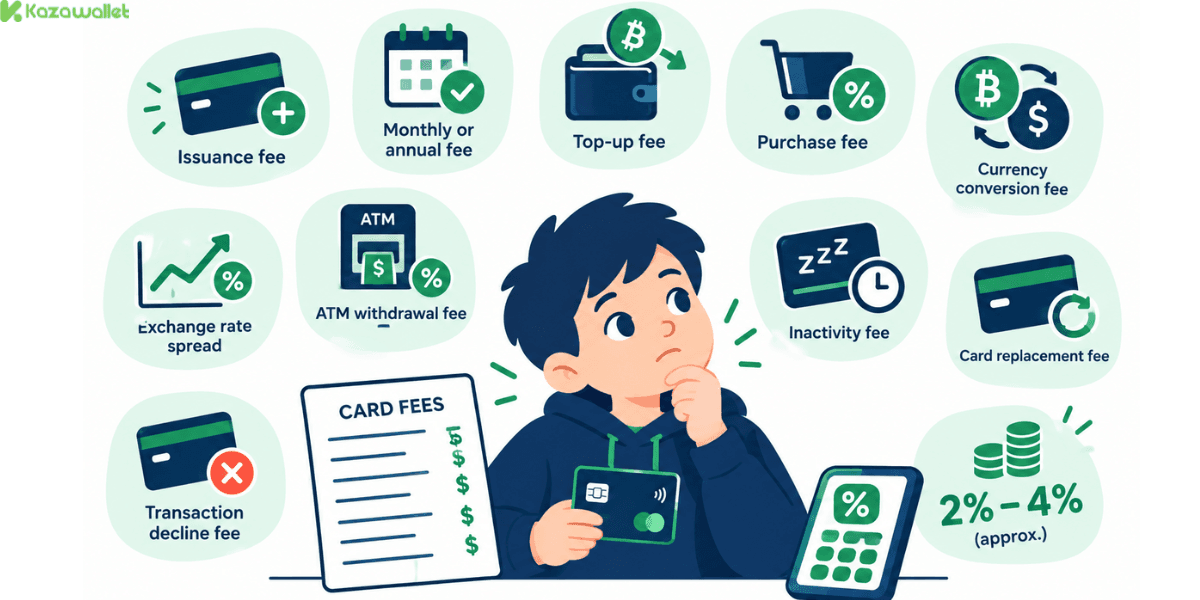
Use the following list as a reference guide when reading the card fee items for any offer:
Issuance fee: A one-time amount paid when creating the card.
Monthly or annual fee: For keeping the card active.
Top-up fee: A percentage or flat amount when funding the card.
Purchase fee: A flat fee or percentage on certain transactions.
Currency conversion fee: A percentage added when paying in a currency other than the card's currency.
Exchange rate spread: The difference between the real rate and the applied rate, a cost that doesn't always show up as a fee.
ATM withdrawal fee: Both the issuer and the ATM operator might charge this.
Inactivity fee: A recurring amount if you don't use the card for a certain period.
Card replacement fee: For loss or damage.
Transaction decline fee: Charged by some cards when a transaction fails due to insufficient funds.
Some industry guides estimate that a crypto card user might effectively pay between 2% and 4% of their spending value if they add up the top-up, conversion, and foreign transaction fees, but these figures vary wildly between providers and are not a strict rule.
How Do You Pay Hidden Fees Inside the Exchange Rate Spread?
One of the most ambiguous card fee items is what happens when you pay in a currency different from your card's, where one currency must be converted to the other.
The rate at which the conversion occurs might be close to the real market rate (called the mid-market rate), or it could be further away. This distance is the exchange rate spread:
It doesn't appear as a line item: There is no line in your bank statement called "spread"; you only see the final amount.
You can calculate it: If the reference rate is 1.000 and the rate applied to you is 1.027, the spread is 2.7%. (A hypothetical example for illustration).
It may replace a fee: Some providers advertise a 0% conversion fee while making up the cost through a wider spread between the buy and sell rates, as noted by specialized reports like this explanation on CryptoPotato.
European law as a model of transparency: EU Regulation 2019/518 mandates expressing the currency conversion cost in card transactions as a percentage mark-up over the European Central Bank's reference rate, with a notification to the customer after the transaction. For details, see Deloitte's explanation of the regulation.
Limits of this rule: It primarily applies to transactions within the EU and in its currencies, and doesn't automatically apply to all countries and currencies, so don't assume it protects you everywhere.
Should You Choose to Pay in Your Home or Local Currency When Traveling?
When you pay with your card in a foreign country, the payment terminal might ask: Do you want to pay in your home currency instead of the local currency? The offer seems convenient because it shows the amount in a currency you understand.
This is Dynamic Currency Conversion (DCC):
How it works: The conversion is done at the point of sale at a rate determined by the service provider, not your bank, and a markup is added.
Markup size: Analyses indicate that the margin for this service is often between 3% and 7% above the interbank rate, and can reach 12% or more in some cases, as noted in Wikipedia's summary of the service.
You might pay twice: Some issuers impose a foreign transaction fee as one of their core card fee items even on a transaction conducted in your card's currency via this service.
Rule of thumb: Choose to pay in the local currency of the country you are in, as it is usually cheaper.
If a mistake happens: Your receipt will show a specific exchange rate, and you can dispute it with your issuer.
We discussed this point in the digital traveler's diary in A Week in the Life of a Digital Nomad's Wallet.
Are "No Fee" Payment Cards Really Free?
The statement is sometimes true and sometimes incomplete. It can have multiple meanings:
No issuance fee: Doesn't mean no exchange rate spread.
No provider fees: Doesn't waive the network fee when topping up with crypto. According to expert explanations, an issuer can reduce its fees to zero, but cannot eliminate the network fee paid to transfer funds on the blockchain.
Impact on small amounts: A flat $5 network fee on a $50 top-up equals 10% before you even buy anything. (Illustrative example).
Free up to a certain limit: Then fees start kicking in once exceeded.
Fine print: It might mention at the bottom of the page that a price spread applies upon purchase or exchange.
The rule: Every provider bears real costs for networks and banks. If a fee doesn't appear among the advertised card fee items, look for where the cost was placed.
How to Read Card Fee Items to Avoid Surprise Costs?
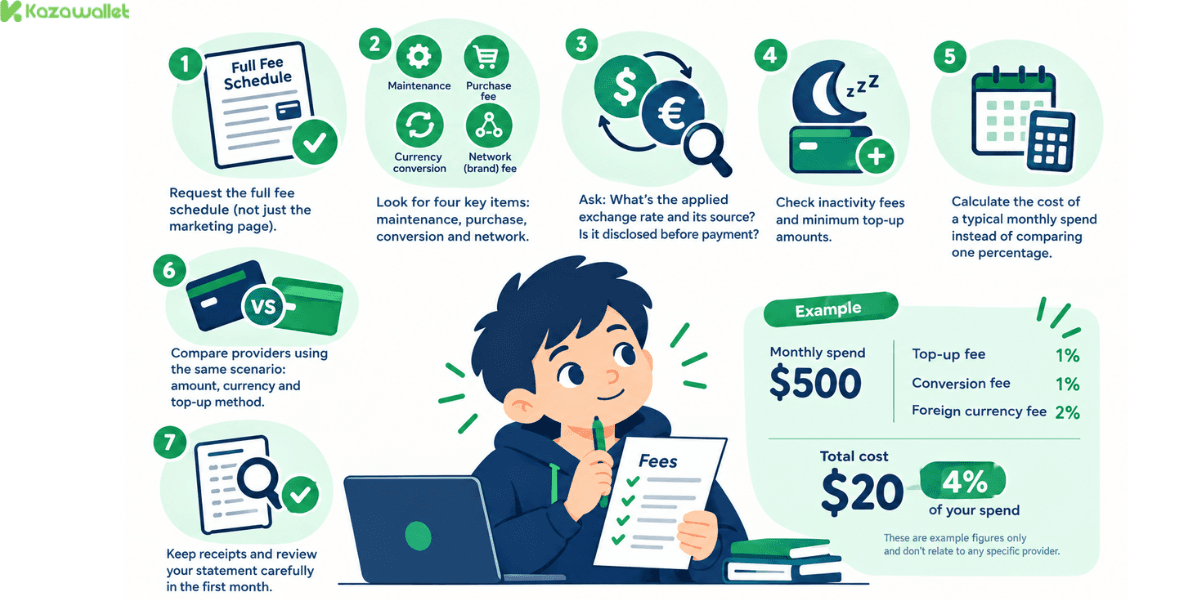
When considering card fee items practically, you can follow these steps:
Request the full fee schedule and don't rely solely on the marketing page.
Look for four main items: maintenance, purchase fee, currency conversion method, and top-up network.
Ask: What is the applied exchange rate, what is its reference, and is it disclosed to you before paying?
Check for inactivity fees and minimum top-up limits.
Calculate the cost of a typical month's spending instead of comparing a single advertised percentage.
Compare providers using the exact same scenario: same amount, same currency, same top-up method.
Keep your receipts and meticulously review your first month's statement.
A simple hypothetical example: If you spend $500 a month, and the top-up fee is 1%, the conversion spread is 1%, and the foreign transaction fee is 2%, the cost is about $20, or 4% of your spending. These are illustrative figures and do not apply to any specific provider.
How Can You Reduce Your Card Fees and Avoid Extra Costs When Paying?
To control card fee items and keep them to a minimum, follow these tips:
Pay in the local currency when offered the choice to pay in your home currency.
Choose a low-cost network when topping up with cryptocurrency.
Reduce the number of small top-ups, because a flat fee impacts small amounts more heavily.
Use a stablecoin, so what you hold doesn't fluctuate in value between top-up and payment.
Withdraw cash only when necessary, as both the issuer and the ATM operator might charge fees.
Enable transaction notifications so you know the applied exchange rate immediately after paying.
Know who holds your funds and what currency funds your card.
How Does Kazawallet Help You?
Understanding fees starts with knowing exactly what you own and in what currency.
This is where the Kazawallet virtual card comes in:
Crypto funding: Deposit your crypto balance, or buy Bitcoin and Ethereum directly within the platform.
Direct swapping: Instantly swap your balance to USDT or USD to create a stable-value balance for allowance and saving, without waiting periods or extra verification steps delaying your funds.
Card top-up: Top up a virtual Visa card from this balance to cover your family's online needs, wherever Visa is accepted. Find details in How to Pay with Crypto via the Kazawallet Virtual Visa Card 2026.
Budget allocation: Track your digital and traditional balances in one place, and distribute them yourself among spending, saving, and giving, just as you teach your children.
- Tap to pay from your phone: add the card to Apple Wallet or Google Wallet, and learn how to turn your crypto balance into instant payments through Google Pay.
- A clear balance in one place: manage your digital and traditional balances together, and follow your spending across multiple tools with clarity.
Read more about everything you need to know about the Kazawallet virtual cardSince card fee items can change, always review the current fee schedule and terms of use for the card and swaps before any transaction, just as you would with any other card.
Frequently Asked Questions
What is the difference between a conversion fee and an exchange rate spread?
A conversion fee is one of the advertised card fee items given as a percentage or flat amount, clearly visible in the fee schedule. The spread, however, is the difference between the real rate and the rate applied to you, and it usually doesn't appear as a standalone item, though it affects the final amount. Therefore, it's recommended to compare the final amount with what you calculate using the reference rate.
Is there really a "no fee" card?
There may be cards devoid of certain advertised fees, but every provider incurs network and banking costs. Often, the phrase means the absence of a specific fee, while the cost might be hidden in another item like the spread. Read the fee schedule and how the exchange rate is calculated before relying on the claim.
Why does a different amount appear on my statement than what I saw at the time of payment?
Because what you see at the moment of payment is an initial authorization. The final settlement happens later and may be subject to a different exchange rate.
Should I agree to pay in my home currency when the terminal offers it?
Usually no, as its rate is typically higher than the conversion your card issuer would perform. If you are in a country that displays costs, compare the offered percentage with what you expect, and choose to pay in the local currency.
What are inactivity fees?
A recurring amount charged by some cards if you don't use them for a specified period. The inactivity duration and the amount vary by provider, so be sure to check this item in the fee schedule.
Is the network fee (Gas) a fee imposed by the card?
No, it's a cost paid to the blockchain network to transfer funds, and the issuer cannot waive it. Its value varies depending on the network and its congestion, and it can heavily impact small top-ups.
How do I know the real exchange rate?
Compare the rate applied to you with a reliable reference rate, like the European Central Bank reference rates for Euro pairs, or mid-market rates from a known source, then calculate the spread as a percentage.
Disclaimer
This article is educational and does not constitute financial or legal advice. The fees and percentages mentioned are examples and estimates from public reports, which vary significantly among providers and countries and change constantly. Verify the current fee schedule with the issuing entity and the applicable laws in your country.
In Conclusion
The most expensive costs among card fee items are not always the most visible. They are often the small, scattered ones, or those hiding inside the exchange rate without carrying the name of a fee.
This doesn't mean every provider hides them, but rather that a conscious reading of card fee items protects you from surprises. Request the complete fee schedule, ask about the reference rate, pay in the local currency, and compare your actual spending cost.
The clearer the questions become, the harder the answer is to hide.