If a digital nomad's wallet kept a diary, its pages would be packed with an endless blur of currencies and border crossings: a USD payment from an American client, a Euro transfer from a European one, followed by an attempt to pay rent in a city you just arrived in yesterday, whose local currency you barely even know.
This is the everyday reality for a digital nomad's finances.
In this article, we follow this wallet day by day, breaking down the financial hurdles it faces in each situation, and exploring the practical solutions that remote workers worldwide have adopted to overcome them.
Quick Summary (TL;DR)
A digital nomad's wallet faces a recurring pattern of challenges every week: receiving payments in different currencies and on different blockchain networks from clients around the world
dealing with landlords or service providers who don't accept crypto directly, avoiding the dynamic currency conversion trap on every purchase, and facing steep cash withdrawal fees every time a border is crossed.
The solution many digital nomads rely on today combines a stablecoin balance as a store of value with a payment card that instantly converts that balance into local, spendable currency wherever they are, without needing a separate bank account in every country they visit.
How does a digital nomad's week start? The day of three payments
Monday, or really any start-of-week day, is usually payday.
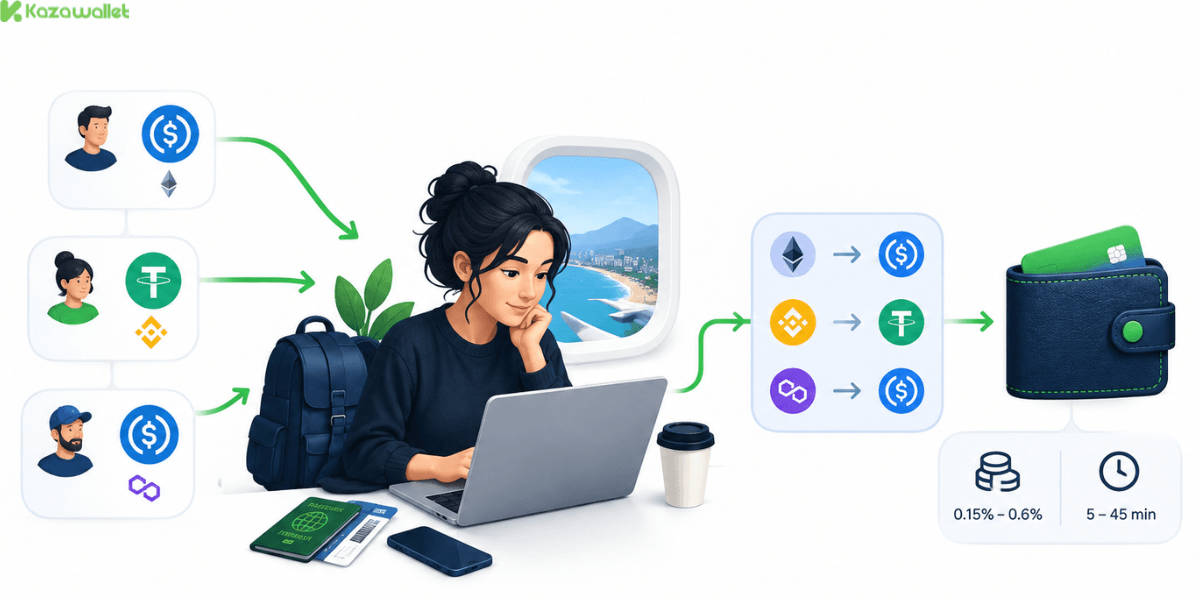
The problem is that these payments rarely arrive in a unified form. It's extremely common for a digital nomad to receive payments from different clients in different stablecoins, on completely different blockchain networks, all at once:
- A payment in USDC on the Ethereum network from one client.
- A payment in USDT on the BNB Chain network from a second client.
- Another payment, again in USDC, but this time on the Polygon network, from a third client.
If the user tries to convert all of these payments into a single card that only supports one blockchain network, they typically lose somewhere between 0.15% and 0.6% of each transfer's value in cross-chain bridging fees, plus a wait time ranging from five to forty-five minutes per transaction, according to recent analysis from 2026.
This fragmentation across networks isn't just a technical annoyance, it's a real, recurring weekly cost for anyone earning income from multiple sources.
What happens on the day you pay rent to a landlord who doesn't accept crypto?
This is where one of the most common paradoxes in a digital nomad's life shows up: their actual balance is held in stable crypto, but the landlord, or the electric company, or even the local internet provider, only accepts a traditional bank transfer in the local currency.
This exact gap, between holding stable digital value and needing to spend it in a traditional way, is what we explained in detail in Crypto Cards vs. Currency Collapse: A Tale of Two Volatilities, though it shows up here in a slightly different context: not a collapsing local currency, but simply a merchant or service provider not yet set up to deal with crypto directly.
The solution many digital nomads have adopted is using tools that convert a stable balance into an actual local bank transfer in the host country's currency, without needing to open a separate bank account in every country they stay in, especially since some of these tools now cover transfers across more than 80 currencies in over 170 countries worldwide.
How does a digital nomad's wallet avoid the dynamic conversion trap on every purchase?
Midweek is usually when regular daily spending kicks in: coffee, a meal, a shared workspace.
This is where a common trap shows up, known as Dynamic Currency Conversion (DCC): when you pay with your card in a foreign country, the payment terminal sometimes asks if you'd like to pay in your home currency instead of the local one.
That option sounds convenient at first, but it usually hides an exchange rate far worse than the actual market rate.
The rule experts in this space recommend is clear: always choose to pay in the local currency of the country you're in, not your home currency, no matter how convenient the other option looks.
On top of that, digital nomads typically face another weekly recurring challenge: multiple digital subscriptions, from a VPN to cloud storage to coworking spaces and entertainment subscriptions, which may get billed in entirely different currencies depending on where the provider company is based.
What happens on travel day to a new country?
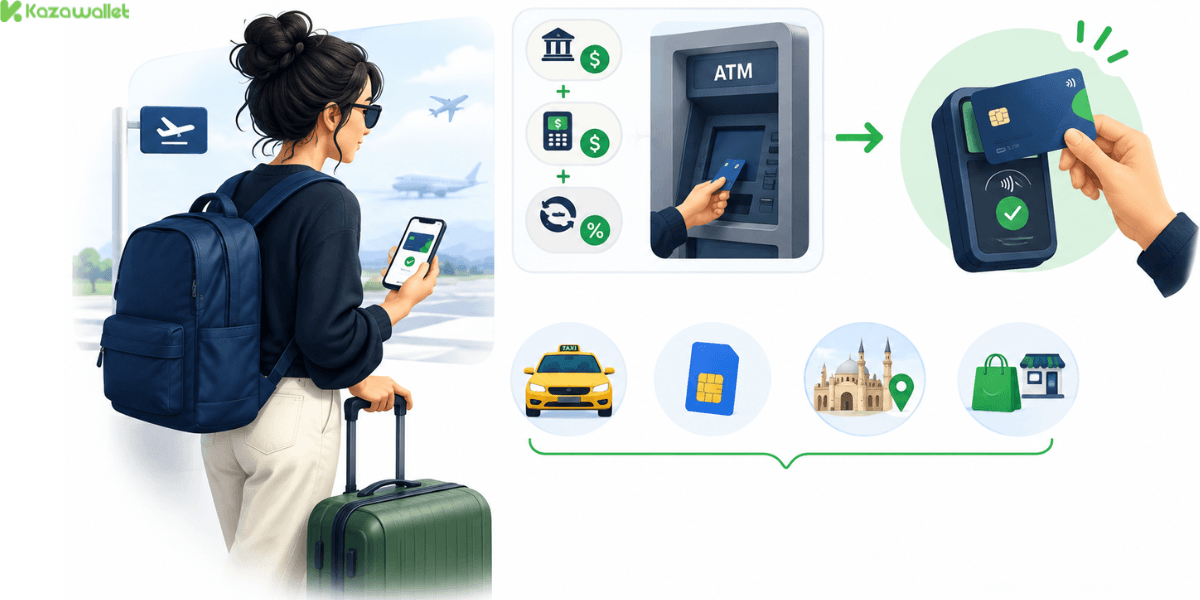
Travel day differs from the rest of the week with an immediate, different need: getting access to the local currency as fast as possible, whether for a taxi from the airport or a local SIM card.
Withdrawing cash from an ATM in a new country usually comes with double fees, one from the card-issuing bank and another from the local ATM itself, on top of an exchange rate spread.
This is where an instant payment card, capable of converting a stable digital balance into spendable currency at the exact moment of payment, becomes a genuinely practical tool, through the same fast verification process we explained in The Invisible Milliseconds: What Really Happens When You Tap to Pay.
How does a digital nomad's wallet protect its savings from crypto volatility by week's end?
By the weekend, a completely different question comes up compared to the daily spending questions: what do you do with whatever's left over after covering your expenses?
Many digital nomads hold onto part of their income in volatile cryptocurrencies like Bitcoin or Ethereum, hoping their value will rise, but that decision carries a genuine psychological conflict we explained in detail in The Psychology of Spending Crypto: Why It Feels Different Than Cash, specifically around the fear of future regret that pushes many people to hesitate spending their volatile coins even when they genuinely need to.
The practical rule experienced digital nomads follow is simple: keep the portion earmarked for immediate spending, like rent and fixed monthly expenses, in a stable currency unaffected by market swings, while any genuine surplus meant for long-term investment stays completely separate from the everyday spending budget.
How does a Kazawallet card help a digital nomad's wallet in practice?
Everything we've covered throughout this hypothetical week comes down to one real need: a tool that combines stable value with the ability to spend it wherever you are.
The Kazawallet virtual Visa card, funded directly from your digital balance, offers a practical solution to most of the situations we walked through this week:
- Direct conversion to USDT or dollars, meaning regardless of which currency or network your payment arrived on, you can convert your balance into one unified, stable value with no added complexity, and with no waiting periods or verification steps delaying your money.
- Load a virtual Visa card from that stable balance to spend anywhere Visa is accepted, whether you're at a morning café or paying a monthly subscription for a remote-work tool. For the full details, check out everything you need to know about the Kazawallet virtual card.
- Manage both your crypto and traditional balances in one place, giving you one clear, unified picture of your money instead of tracking several separate wallets and platforms across one busy work week.
That way, whether your next payment lands in dollars, euros, or a stablecoin on an entirely different network, you get one unified way to turn it into actual spending, without your week turning into a string of recurring financial headaches.
Frequently Asked Questions
Does a digital nomad's wallet need a bank account in every country they visit?
Not necessarily. Many modern tools let you convert a digital balance into local bank transfers across dozens of countries without needing to open a separate account in each one.
Why does the cost of converting crypto differ between blockchain networks?
Because moving assets between different networks, known as bridging, requires extra technical steps and longer processing time, which translates into higher fees compared to a transfer within the same network.
What exactly is the dynamic currency conversion trap?
It's an option a payment terminal offers, letting you pay in your home currency instead of the local one, but it usually applies an exchange rate worse than the actual market rate, so it's always recommended to choose payment in the local currency instead.
Should I keep my entire balance in stablecoins?
That depends on your personal goals, but the common practical rule is to separate the portion earmarked for immediate spending and fixed expenses from any portion you intend to invest long term.
In closing
A week in the life of a digital nomad's wallet isn't an exception; it's a recurring pattern lived by everyone who works remotely and moves between countries:
payments in multiple currencies, landlords who only accept traditional transfers, hidden conversion traps, and cash withdrawal fees at every new border.
The solution that's emerged to deal with all of it isn't one magic tool, it's a combination of a stable-value balance and a payment card that instantly turns it into real spending, no matter where you are or which currency your last paycheck arrived in