About one second, that's roughly all the time between the moment your phone touches the payment terminal and the moment you hear the approval beep. A complete financial transaction wraps up as if it required no effort at all.
But behind that apparent simplicity, a precise chain of operations runs through several different financial parties, all before you even lift your hand off the terminal.
This article walks through, step by step, how tap to pay works during that moment we've come to take for granted.
Quick Summary (TL;DR)
To understand how tap to pay works within a fraction of a second, here's the short version: when you tap a payment terminal, it sends out a low-power radio wave that wakes up the chip inside your card or phone, no battery required in the card itself.
If you're paying with your phone through a digital wallet, your real card number was already swapped out for a fixed substitute number the moment you first added the card, a process called Tokenization, and that substitute number gets sent along with an extra code that changes with every transaction.
This encrypted data travels through the card network to your issuing bank for approval, and the response usually comes back within roughly 300 to 700 milliseconds.
Here's the important part: that quick approval only means the bank allowed the transaction, not that the money actually left your account, that happens later, usually within a day or two.
How tap to pay works from the moment you tap your card on the terminal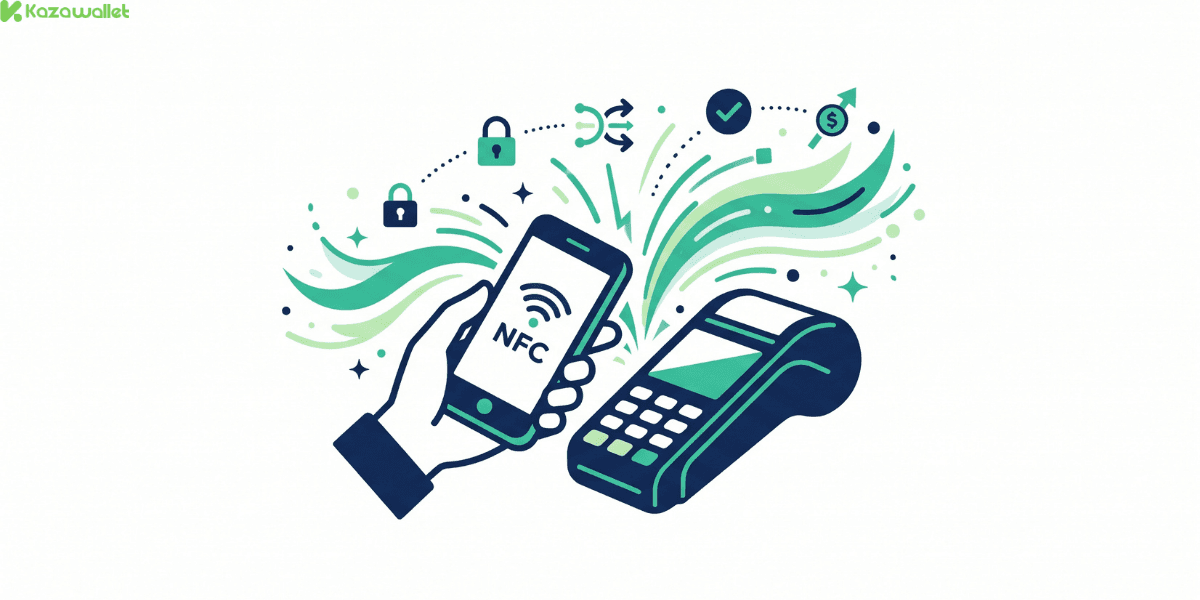
The payment terminal constantly emits a low-power electromagnetic field, using NFC payment technology (Near Field Communication), operating at a fixed frequency within a very short range of about four centimeters.
When your card or phone gets within that range, here's what happens:
- A small antenna inside the card or phone picks up this electromagnetic field.
- The chip draws the power it needs to activate straight from that wave, even though it has no battery of its own, much like some devices charge wirelessly without a direct cable.
- The chip immediately begins exchanging data with the terminal, all within a fraction of a second.
This short range is a deliberate design choice, and it's a security feature, not a technical limitation, since it prevents any device further away from picking up your card's data without your knowledge.
If you want to dig deeper into how this technology specifically works for in-store payments, you can check out our detailed guide on what NFC technology is.
How does your card's data turn into an encrypted code within a fraction of a second?
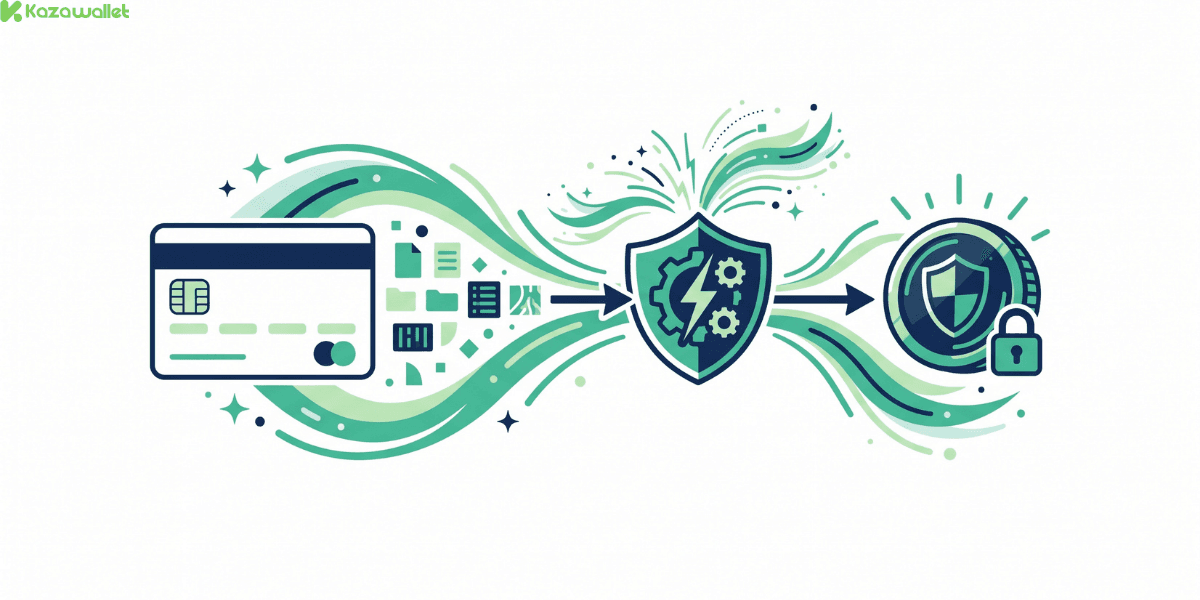
Here's a precise technical point a lot of people mix up, and the answer depends on which device you're paying with:
- A physical plastic card: doesn't actually perform tokenization in the strict sense. The chip sends your real card number, encrypted, paired with a dynamic authorization code (a cryptogram) that changes with every new transaction, to prevent the data from being reused if intercepted.
- A phone through a digital wallet like Apple Pay & Google Pay: this is where real Tokenization happens.
The moment you first add your card to your phone, your bank and the card network replace your real card number with a fixed substitute number specific to that device, stored in a secure part of the phone.
On every transaction after that, your phone sends this substitute number along with an extra dynamic code that changes each time, never your actual card number.
What about the Kazawallet card specifically?
Since your Kazawallet virtual card is used in practice through a digital wallet on your phone, what's actually happening is this second scenario specifically: your real number is never stored or sent from your phone at all, a secure substitute stands in for it at all times.
The practical benefit is clear in both cases: even if someone managed to intercept this data in transit, it's useless to them, because it's only valid for that one transaction and can't be reused later.
According to data from Visa, this technology alone has helped prevent more than $650 million in potential fraud losses across its network, after issuing more than 10 billion tokens of this kind so far.
When you pay through a digital wallet on your phone instead of a physical card, an extra layer of protection kicks in: you're usually asked to confirm your identity with a fingerprint, face scan, or device passcode, before your phone sends any payment data at all.
You can check out the full steps for adding your card to your digital wallet in how to add your Kazawallet Plus card to Apple Wallet (Apple Wallet & Apple Pay), or how to add your Kazawallet virtual card to Google Wallet step by step.
Who actually approves the payment, and how does it happen this fast?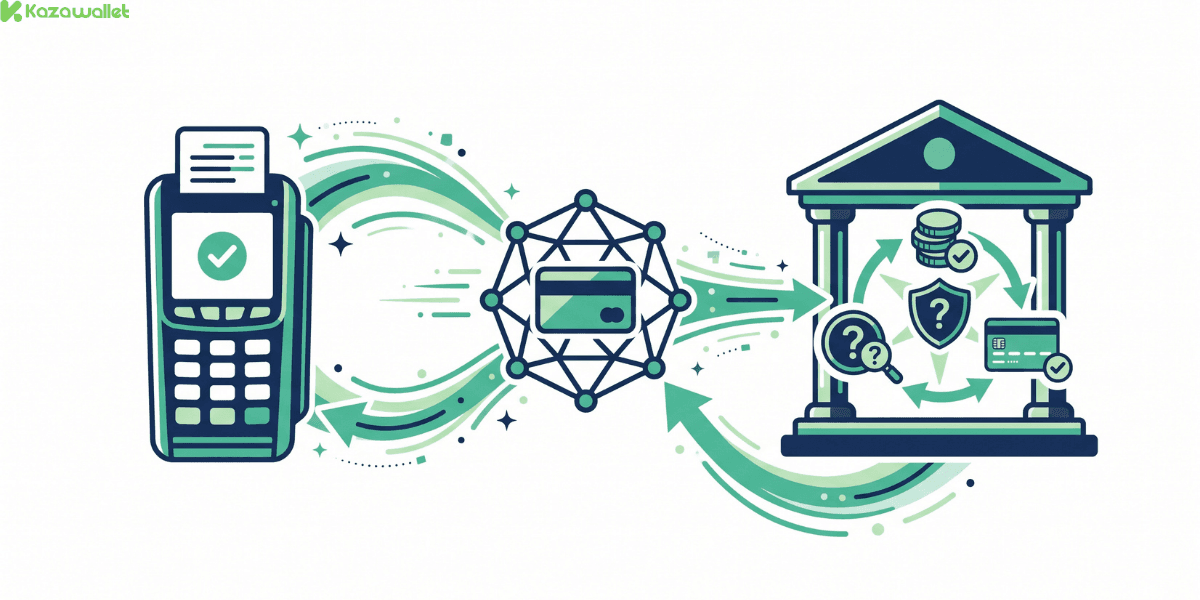
Once the encrypted code is generated, it begins a short but precisely organized journey:
- From the payment terminal to the card network (like Visa).
- From the card network to your specific issuing bank.
- At this moment, the bank checks several things almost simultaneously: is there enough balance? Are there any fraud red flags on this transaction? Is the card still valid and active?
- The approval or decline decision travels back through the same path to the terminal.
One payment card industry specialist described this moment as being like a quick "handshake" between the terminal and the bank, where the bank essentially says: "this is one of my cards, this is a transaction from one of my customers, and I approve it."
This entire handshake, from sending the request to receiving the response, typically takes somewhere between 300 and 700 milliseconds, which is the moment right before that familiar green light or beep.
Does instant approval mean the money already left your account?
This is a point a lot of people get wrong, and it's worth clearing up. What happens during those fractions of a second is technically called "Authorization", a confirmation from the bank that the transaction is approved and allowed, with the amount usually placed on hold against your available balance.
But the actual transfer of money between your bank's account and the merchant's account, known as "Settlement", happens later, usually within one to two business days, when thousands of similar transactions get batched together and processed at once across the banking network.
This explains something you may have noticed before: a payment showing up as "Pending" in your banking or wallet app for a short while, before it turns into a final, completed transaction.
Is tap-to-pay safe despite all this speed?
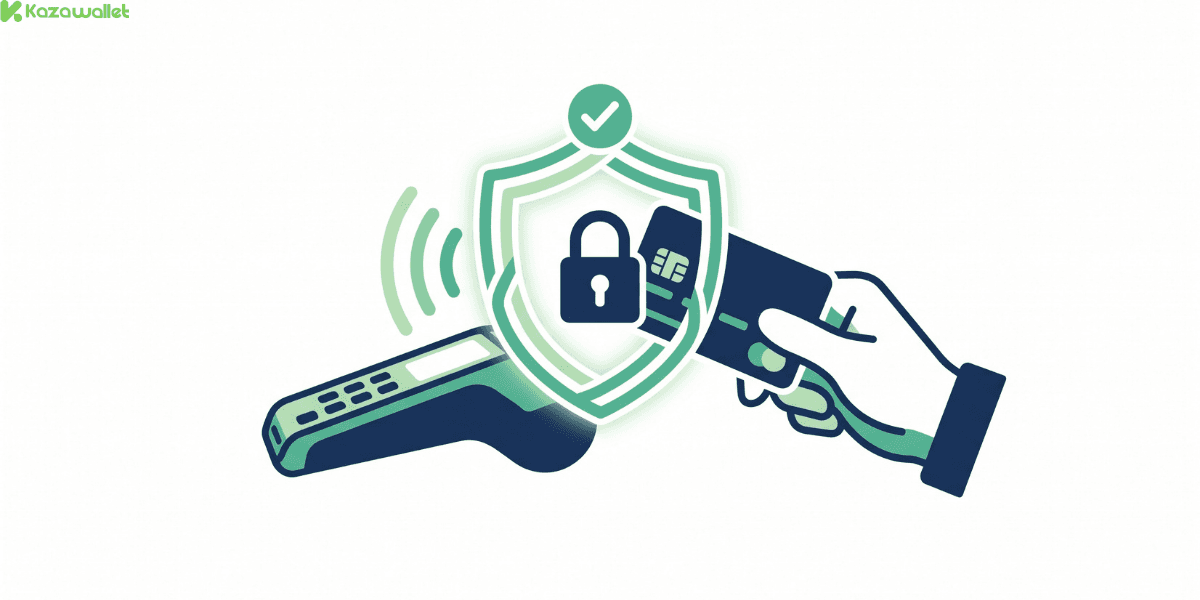
This kind of speed might seem worrying at first glance for a contactless payment process, but here, tap to pay security isn't at odds with speed, it's deliberately built on top of it:
The very short range blocks any remote attempt to intercept your data.
The dynamic code that changes with every transaction makes any intercepted data useless afterward.
The biometric verification layer in digital wallets on phones adds an extra barrier that older, traditional cards simply don't have.
This level of security is one of the reasons tap-to-pay now accounts for more than 60% of all in-person transactions in some major markets, and surpasses 90% in others, according to recent data.
How does this speed connect to your Kazawallet virtual Visa card?
Understanding what happens behind these tiny fractions of a second helps you trust a process that looks simple but is, in reality, organized with a high degree of precision.
When you use a Kazawallet virtual Visa card, you're tapping into this exact same system in practice:
Loading the card directly from your digital balance, through direct conversion to USDT or dollars, with no waiting periods slowing you down before you can use the card. If you haven't gotten your card yet, check out how to get a virtual Visa card in Syria.
Using the card to pay anywhere Visa is accepted online, through the same globally-adopted authorization and encryption process, or even paying directly from your crypto balance, as explained in how to pay with crypto using your Kazawallet virtual Visa card in 2026.
Converting your crypto balance into instant payments through your digital wallet, at the same speed we've broken down in this article, detailed in how to convert your crypto balance into instant payments through Google Pay.
A clear balance, updated instantly after every transaction, instead of waiting around to confirm a payment went through.
For a complete overview of everything this card offers in one place, check out everything you need to know about the Kazawallet virtual card.
That way, you get the same level of speed and security that global payment systems rely on, while managing your digital balance with full clarity from one single place.
Frequently Asked Questions
Can someone steal my card data if they just walk by me with a reader?
This is very unlikely in practice, because of the extremely short range needed to activate the chip (under four centimeters), plus the fact that any intercepted data is encrypted and only valid for a single transaction, so it can't be reused.
Why does a payment sometimes show as "pending" in my banking app before it's finally deducted?
Because what happens at the moment of payment is an instant authorization that places a hold on the amount, while the actual, final transfer of funds between banks happens later, usually within one to two business days.
Is paying through a digital wallet on my phone more secure than a traditional card?
Both are secure thanks to the dynamic code that changes with every transaction, but there's a subtle difference: a physical card sends its real number along with that code, while a phone through a digital wallet always uses a substitute number instead of your real one, plus a fingerprint or passcode verification layer before any payment data is sent at all.
Why doesn't a payment card need a battery to work?
Because the power needed to activate the small chip inside the card comes from the electromagnetic field the terminal itself emits the moment you bring your card close to it, with no need for any internal power source in the card.
In closing
That moment that seems so simple when you tap a payment terminal actually hides a precise chain of steps:
a radio wave waking up a dormant chip, an encrypted code generated and sent in place of your real card number, and a fast data journey between several financial parties, all within under a second.
Understanding how tap to pay works obviously doesn't make the payment process any slower, but it does give you a greater appreciation for just how much technical complexity works quietly behind every simple tap you make every day.