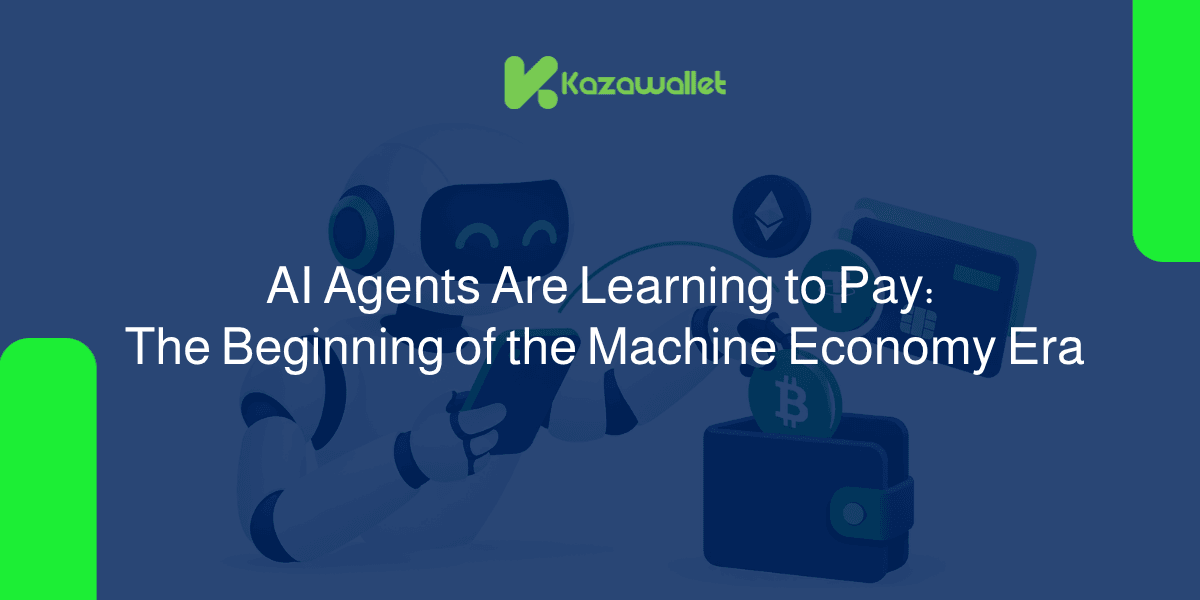
In 1997, the designers of the web reserved a special code for payments inside its core protocol, number 402, and then left it unused for roughly three decades.
Today that code is back at work, not letting humans pay, but letting an AI agent pay for data or a service in a stablecoin, in a fraction of a second and without creating an account.
That's how AI agent payments went from a technical idea to an infrastructure that major companies are building.
In this article, we explain why agents need a new way to pay, how it works, what has actually changed in the market, whether the headline numbers reflect real demand, and what's still missing before we can talk about a real machine economy.
Quick Summary (TL;DR)
AI agent payments means a smart program pays for data or services on its own, without a human approving each transaction. The leading path today is the x402 protocol, which Coinbase launched in May 2025.
It uses the HTTP 402 code to tell the agent the price, so the agent signs a stablecoin payment and gets the resource with no account and no card.
Cloudflare backs it through a joint foundation, and other companies are building wallets and payment gateways around it.
But the numbers need context: Coinbase reported more than 165 million cumulative transactions worth roughly $50 million in total, while real daily commercial volume was estimated at around $28,000, and analysts estimate that close to half of the activity may be artificial.
The takeaway: the machine economy has its first layer of infrastructure, but real demand for it is still at an early stage.
Why do AI agent payments need a new system?
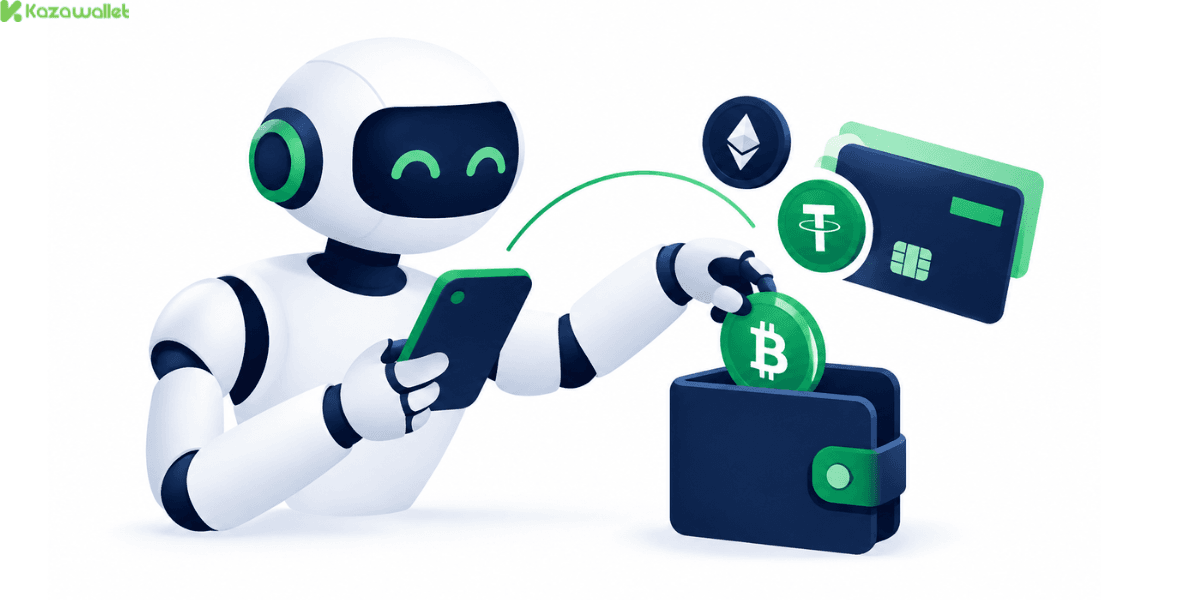
An AI agent is a program that carries out tasks by itself: it searches for a flight, compares APIs, pulls data, or calls another model for processing. What it struggles with is paying the way systems built for humans expect:
- It can't open a bank account, or pass identity and credit checks.
- It can't complete a traditional checkout every time, from entering card details to getting past "I'm not a robot" tests.
- Micropayments: many services an agent buys are priced at a few cents or less, and in traditional systems the fixed fee per transaction can exceed the value of the transaction itself.
- It works around the clock: no office hours, no holidays.
That's where stablecoins look like a logical candidate: programmable, available around the clock, and suited to small amounts that are hard to move through traditional channels at a sensible cost.
How Do AI Systems Actually Make Payments? The x402 Protocol
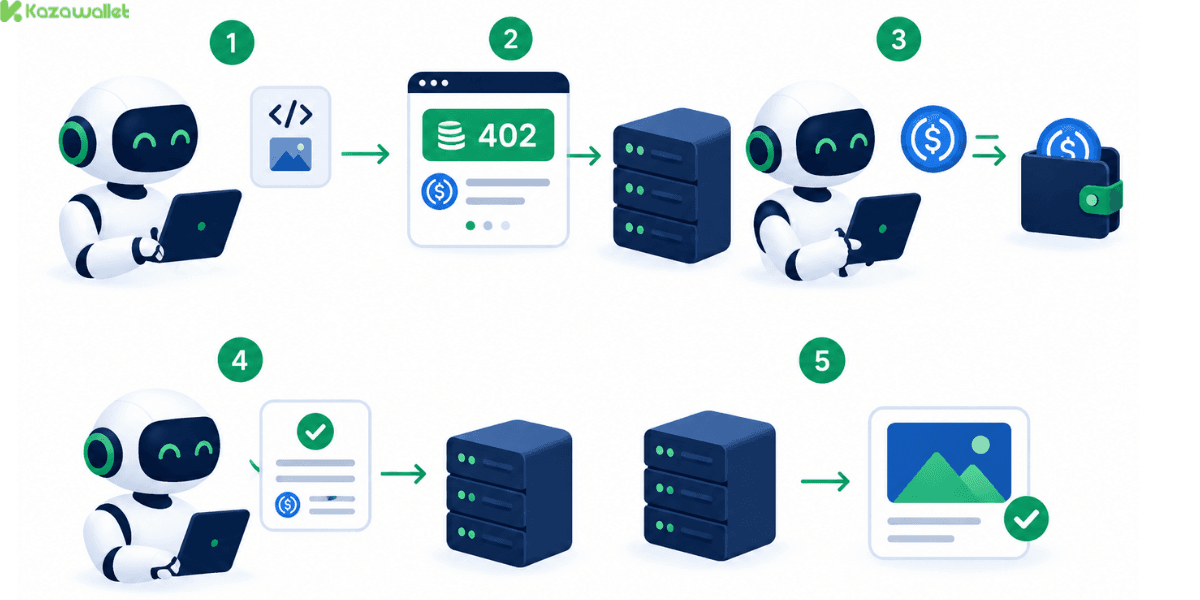
The leading path today relies on the x402 protocol, an open standard Coinbase launched in May 2025.
Its idea is to reuse the "402 Payment Required" code that has sat reserved in the web's specifications since 1997 with almost no real use. The process goes like this:
- The agent requests a resource, such as data, an API, or a processing result.
- The server replies with a 402 "Payment Required" code, along with payment details: the amount, the network, and the type of currency.
- The agent signs a stablecoin payment, usually USDC, from its wallet.
- The agent repeats the same request with proof of payment attached.
- The server verifies the payment and delivers the resource.
No account registration, no access key, no invoice, and no manual payment step. In September 2025, Cloudflare helped found the x402 Foundation to govern the standard as an open specification.
Which Companies Are Building the AI Payments Infrastructure Today?
Complementary layers are taking shape across different players:
- Coinbase: the protocol's creator, providing tools for creating agent wallets and handling a large share of processing.
- Cloudflare: announced tools that let websites charge agents in USDC over the Base network, currently in a closed beta for eligible US businesses, with wider availability targeted for early 2027. In August 2026 it also introduced a mechanism that lets an agent prove it's acting for a user and spend from a wallet linked to them.
- OSL: launched its AgentPay platform in August 2026, a payment layer supporting multiple stablecoins, according to reports.
- Stripe: is promoting a different protocol called MPP, together with Tempo, since March 2026, combining stablecoins and traditional payments, according to reports.
- Other players: reports point to companies such as Google, Visa, AWS, and Circle joining the foundation or showing interest in it.
That completes the pieces of the idea: an identity for the agent, a wallet, a payment protocol, a stablecoin balance, and a merchant willing to accept payment.
Has the Machine Economy Actually Started, or Is It Still in Beta?
The numbers are striking, but they need careful reading, because their sources and dates differ:
- Reported by Coinbase (April 2026): about 165 million cumulative transactions, roughly $50 million in total volume, and 69,000 active agents.
- Independent on-chain data (February 2026): more than 120 million transactions and more than $41 million.
- Actual daily commercial volume: about $28,000 across roughly 131,000 transactions a day in Q1 2026, an average of around 20 cents per transaction.
- Analyst estimate: close to half of the activity may be artificial or self-dealing.
The explanation for this apparent contradiction is simple: transaction counts can rise because of testing, automated retries, and very small requests, while their dollar value stays limited.
In other words, infrastructure is advancing faster than commercial demand, which makes AI agent payments today closer to a testing phase than a mature market.
The important question is no longer whether an agent can pay, but whether agents will make enough valuable, repeated purchases to sustain a real market.
What Services Will AI Agents Buy on Your Behalf Using Crypto?
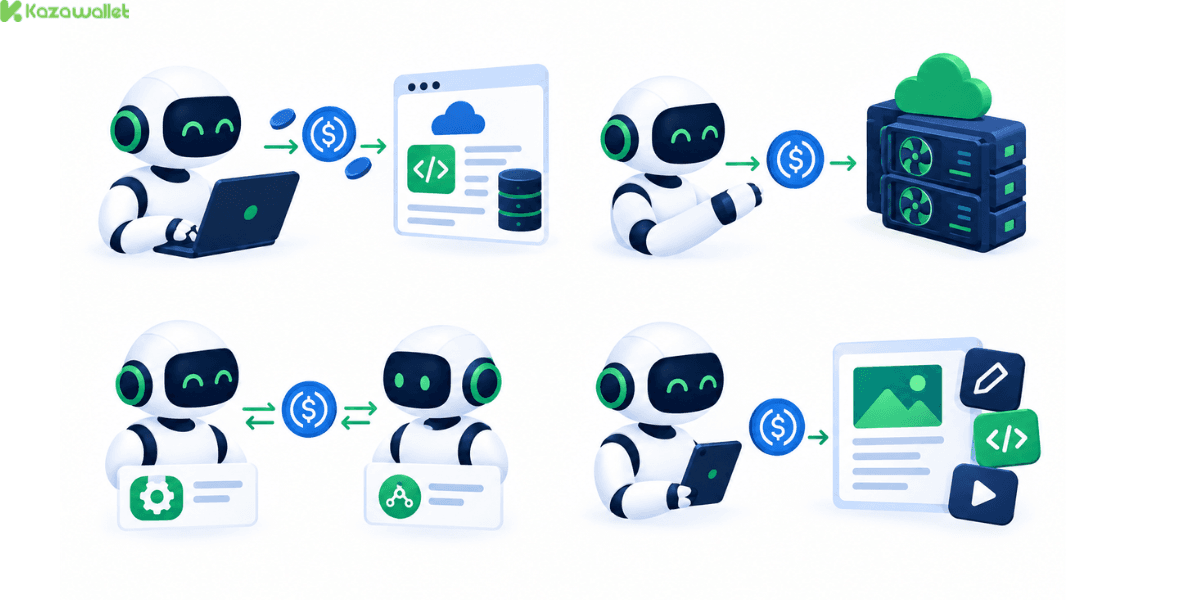
Probably not every smart task will need crypto. The strongest early cases are repeated, low-value transactions where automation matters:
- Data and API access: paying cents per request instead of a monthly subscription.
- AI processing and computing: buying processing power as needed.
- Machine-to-machine services: one agent buying a service from another.
- Digital content and software tools: paying for a single article or tool.
If these cases prove useful, agents could become the most frequent crypto transactors, even if they never become its biggest holders. The new user could be a program spending a few cents thousands of times a day.
It's an extension of what we discussed about money flowing continuously in What If Your Salary Was Paid Every Second Instead of Every Month?.
What Are the Risks and Obstacles of Automated Crypto Payments?
The direction is clear, but real gaps remain:
- Real commercial demand: actual values are still small compared with the size of the announcements.
- Clear spending controls: daily caps, lists of approved merchants, and human oversight that can step in.
- Agent wallet security: an agent holding money keys can be compromised, or tricked by hidden instructions into paying the wrong party.
- Responsibility and compliance: who bears the loss if an agent makes a mistake? And how do anti-money-laundering rules apply? Laws here differ and keep changing, so no single position can be assumed.
- Protocol interoperability: multiple standards, such as x402 and MPP, could fragment developers and merchants.
- Reliable data: separating real activity from artificial activity to measure growth accurately.
How Can You Maintain Control Over Your AI agent payments?
Even if machines pay on their own, a human still funds the balance, sets the limits, and reviews the results. That creates a practical need: moving between a stable crypto balance and real spending on services that still ask for a card:
- Funding the balance: with stablecoins that work as a stable-value working balance.
- Setting limits: how much can be spent, and with whom.
- Spending in today's world: AI tool subscriptions, computing services, and APIs that accept cards.
We explained the bridge between stablecoins and real spending in What Is a Crypto Card and in Crypto Cards vs. Currency Collapse: A Tale of Two Volatilities.
How does a crypto-funded Kazawallet card help in a world where machines pay?
Machines may pay in stablecoins directly through specialized protocols, but you need a bridge that turns your stable balance into spending at places that still accept cards.
That's where the Kazawallet virtual card comes in:
- Funding with crypto: deposit your crypto balance, or buy Bitcoin and Ethereum directly inside the platform.
- Direct swap: swap your balance directly into USDT or dollars to serve as a stable-value working balance, with no waiting periods or extra verification steps delaying your money.
- Loading the card: load a virtual Visa card from this balance to pay for AI tool subscriptions, computing services, and APIs that accept cards, anywhere Visa is accepted online. You'll find the details in how to pay with crypto using your Kazawallet virtual Visa card in 2026.
- Tap to pay from your phone: add the card to Apple Wallet or Google Wallet, and learn how to turn your crypto balance into instant payments through Google Pay.
- A clear balance in one place: manage your digital and traditional balances together, and follow your spending across multiple tools with clarity.
Read more about everything you need to know about the Kazawallet virtual card.
Frequently Asked Questions
What is the x402 protocol in simple terms?
It's a way for a website or service to ask a smart program for payment inside the request itself. The server replies with a "payment required" code and the price, so the agent pays in a stablecoin and gets what it asked for, with no account registration or card details.
Why is code 402 used specifically?
Because it's been reserved in the web's specifications since 1997 under the name "Payment Required," but it was never widely used in practice. The new standard reactivates it for this purpose.
Does an agent need a bank account?
Not in this model. It needs a wallet holding a stablecoin balance, funded by a human or a responsible organization.
Could an agent spend my money without my knowledge?
That depends on how it's set up. Fixed spending caps, approved-merchant lists, and human review are among the most important safeguards, and giving any agent open-ended spending authority isn't recommended.
Are the announced numbers reliable?
Some are reported by the companies themselves without independent audit, some come from on-chain data, and analysts estimate that a large share may be artificial activity. It's best to read them cautiously and not treat them as a decisive sign of demand.
Is x402 the only way for agents to pay?
No. There are other standards such as Stripe's MPP, and the field is at an early stage where the picture may change.
Can I use my crypto balance to pay for AI tool subscriptions?
Many of these tools are paid for by card. You can fund a virtual Visa card from your digital balance and pay anywhere Visa is accepted, while checking each service's terms and your country's laws.
In closing
Crypto looks technically ready to serve as a payment method for machines, but the demand that would make this economy stand on its own hasn't fully arrived.
Until it does, humans remain the ones who fund, set limits, and review, and it's useful to have a clear bridge between your stable balance and your everyday spending.