When your child asks for their allowance today, they no longer expect a few coins to drop into a piggy bank. Today's children watch us pay with our phones, hear about digital wallets, and might wonder: how do I get my allowance in this world?
Research from Cambridge University indicates that a child's financial habits form by age seven, long before they can grasp the complexities of the economy.
If the future of money is heading toward digitalization and crypto, are crypto allowances for kids a smart educational tool to prepare them for the future, or an unnecessary risk?
In this article, we discuss this idea calmly: from the research and educational aspects, through laws and risks, down to how to implement it safely and responsibly.
Quick Summary (TL;DR)
Crypto allowances for kids are practically possible but come with conditions. In most countries, licensed platforms require users to be 18 to open an independent account.
Therefore, parents remain the account owners and managers, or they use a custodial format where the child is a beneficiary, not an owner.
Cambridge research shows that the foundations of financial habits form early, and research reviews indicate that an allowance alone doesn't build financial skills; it requires an allowance coupled with continuous parental guidance and dialogue.
As for the tool, stablecoins might be more suitable than volatile cryptocurrencies because their value is close to the dollar, preventing the lesson from turning into speculation.
In the future, allowances might become programmable with limits and conditions, but this remains subject to laws and child protection standards.
What is Meant by Crypto Allowances for Kids?
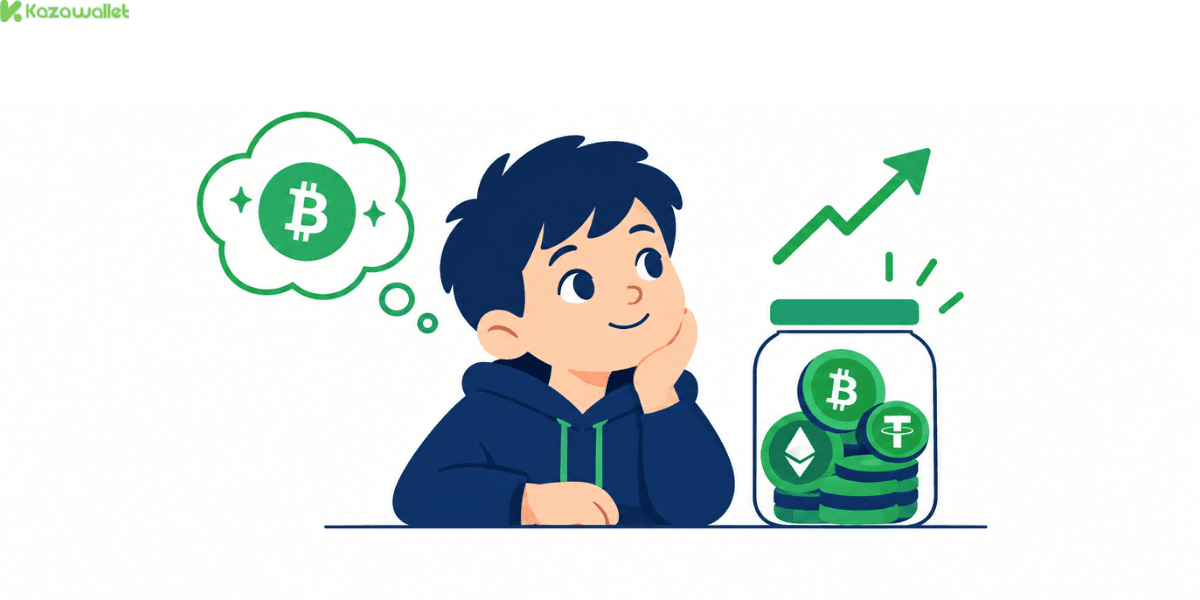
A regular allowance is an age-old educational tool: a fixed amount through which a child learns how to choose, save, and spend. What's new is the medium, which takes several practical forms:
Digital allowance via stablecoin: Parents periodically transfer an amount from their balance, and the child tracks what they own under parental supervision.
Custodial Account: An adult owns and manages the account, the child is the beneficiary, and control transfers to them upon reaching a legal age that varies by country.
Demo wallet: Virtual numbers that teach the concept without real money.
A gift saved for the future: A small crypto amount saved by parents for the child until they grow up.
This does not mean the child trades or speculates with currencies. The goal is educational: understanding value, saving, and making choices.
What Does Research Say About Allowances and Childhood Financial Habits?
Available research on children's financial education discusses allowances generally and helps put the idea into context:
Age of Seven: A 2013 Cambridge University study, commissioned by the UK’s Money Advice Service, concluded that the mental foundations for financial habits, like self-control and planning, form early. Most seven-year-olds understand counting money and that it buys goods, and they can plan ahead and delay decisions.
What the child doesn't realize yet: Children this age usually cannot distinguish between luxuries and necessities.
An allowance alone is not enough: Research summaries citing a review by the US Consumer Financial Protection Bureau state that an allowance alone does not build financial skills; it takes an allowance plus parental guidance and dialogue. The active ingredient is the guidance, not the money itself.
Frequent payments may alter spending: A study on adults shows that frequent payments increase the feeling of wealth and spending. It makes sense for parents to pay attention to the allowance frequency, noting this is an extrapolation from adults, not a direct child study.
No specific evidence for crypto: We found no sufficient studies comparing the impact of crypto allowances against cash allowances on financial habits.
What Does the Law Usually Allow, and Who Owns the Account?
Laws vary by country, but there are recurring points:
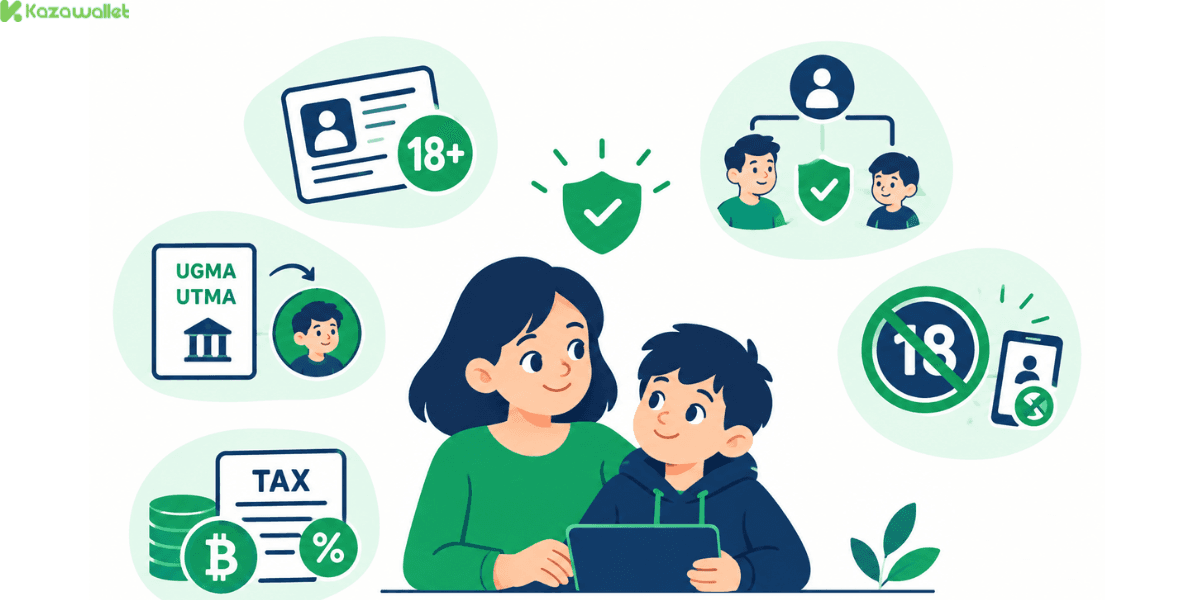
Age limit: Licensed platforms typically require the account holder to be 18 years old.
Parents' role: Therefore, parents remain the account owners and managers, or use a custodial setup where available.
Ownership at maturity: In the US, for example, custodial accounts for minors are known under formats like UGMA and UTMA. Funds placed in them become the child's legal property, with control transferring at an age determined by each state.
Taxes: Crypto profits may be subject to taxes even if they are in a minor's name. In the US, for instance, the "Kiddie Tax" subjects a child's investment income above a certain threshold to the parents' tax bracket, with limits changing annually.
No bypassing restrictions: Check your local laws and any platform's terms before taking action, and never attempt to bypass age restrictions.
Why Might Stablecoins Be Better for a Child's Allowance?
Understandable value: Their value is close to the US dollar, making it easy for the child to understand how much they have.
No sharp volatility: The lesson doesn't turn into gambling or frustration during a price drop.
Teaching saving and choice: Focuses on budgeting instead of trying to predict prices.
Suitable for splitting: Easily divided into distinct buckets: spending, saving, and giving.
However, stablecoins are not risk-free; they depend on the issuing entity and its commitment to financial backing. As we explained in The Psychology of Crypto Spending: Why It Feels Different from Cash, price volatility makes spending decisions psychologically harder, a burden a child does not need.
What Risks Should Parents Know?
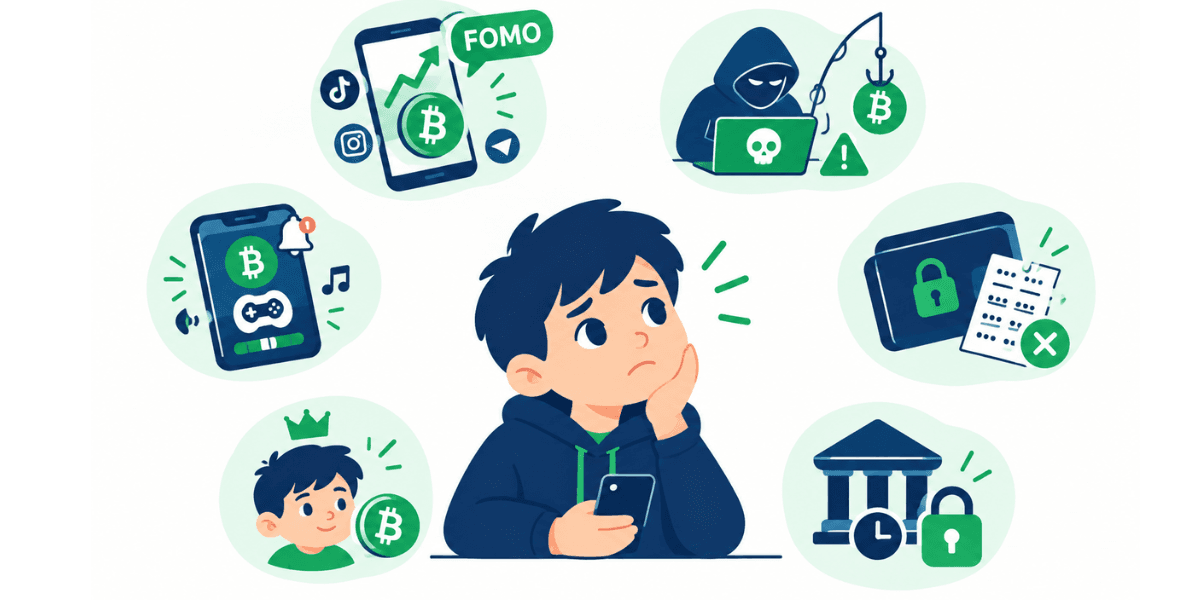
Fear Of Missing Out (FOMO): Children and teens are exposed to social media hype about coins doubling in price. To understand these terms, see Decoding Cryptocurrency Jargon.
Youth-targeted scams: Reports show US regulatory warnings about young investors being targeted on social media. Safety rules can be found in The Unspoken Etiquette of Crypto Dealings.
Lost keys: Losing a seed phrase means a permanent, irreversible loss.
App design: Colors, sounds, and micro-rewards might trigger repetitive engagement, as we explained in One Notification, Ten Emotions: The Emotional Design Behind Push Notifications.
Reliance on the custodian: Access to funds might be delayed if the account is frozen.
Ownership at maturity: In custodial accounts, the child might have full decision-making power upon reaching legal age, without the parents being able to step in.
How to Start Responsibly as a Parent?
When considering crypto allowances for kids as a practical step, you can follow this sequence:
Check local laws and platform terms to ensure the age limits permit your plans.
Start with a demo wallet or very small amounts that can be lost without impact.
Prefer a stablecoin to teach saving and spending.
Divide the allowance into three buckets: spending, saving, and giving.
Talk to your child about the reasons behind decisions; guidance is the active element, not the amount.
Protect wallet keys and passwords; access should never be left solely in the child's hands.
Review the experience every few months and change what doesn’t suit your child.
How Does the Crypto-Funded Kazawallet Card Help Manage Your Family’s Allowance?
If you decide a portion of your family's budget will be in digital currencies, you need a bridge to turn that balance into actual spending, while keeping management and responsibility in your hands as an adult.
This is where the Kazawallet virtual card comes in:
Crypto funding: Deposit your crypto balance, or buy Bitcoin and Ethereum directly within the platform.
Direct swapping: Instantly swap your balance to USDT or USD to create a stable-value balance for allowance and saving, without waiting periods or extra verification steps delaying your funds.
Card top-up: Top up a virtual Visa card from this balance to cover your family's online needs, wherever Visa is accepted. Find details in How to Pay with Crypto via the Kazawallet Virtual Visa Card 2026.
Budget allocation: Track your digital and traditional balances in one place, and distribute them yourself among spending, saving, and giving, just as you teach your children.
- Tap to pay from your phone: add the card to Apple Wallet or Google Wallet, and learn how to turn your crypto balance into instant payments through Google Pay.
- A clear balance in one place: manage your digital and traditional balances together, and follow your spending across multiple tools with clarity.
Read more about everything you need to know about the Kazawallet virtual card
Frequently Asked Questions (FAQ)
Is it legal for a child to own cryptocurrency?
This varies by country. Usually, a minor cannot open an independent account on a licensed platform, but parents can own and manage crypto on their behalf, or use a custodial account where permitted. Always check your local laws.
What is the right age to start?
There is no single correct age. Research suggests children grasp basic money concepts early, but deeper understanding of trade-offs and risks takes time. Start with concepts and demo wallets before introducing real money, and decide based on your child's maturity.
What is a Custodial Account?
It is an account owned and managed by an adult, such as a parent, for the benefit of a minor. Control transfers to the child at a legal age that varies between countries.
Are there taxes on what the child owns?
This can happen in some countries. The US, for example, has specific rules for investment income earned by a minor. Consult a financial expert in your country.
Is a crypto card suitable for a child?
These cards are typically issued to adults and are subject to the issuer's terms and local laws. Review the terms of use, and do not use a card or account in a minor's name unless explicitly permitted by the terms and laws.
How do I protect my child from scams?
Teach them never to share passwords or seed phrases, not to trust fast-profit offers, and to ask you before any transaction. Limit their permissions so they cannot transfer funds alone.
What if the price of the coin I gave my child drops?
This is an opportunity to teach them that prices fluctuate and no one guarantees a profit. However, do not put a significant amount at risk. This is why stablecoins and small amounts are recommended.
In Conclusion
Children can grow up with digital allowances, but what matters most is not the currency itself, but what accompanies it: continuous dialogue, clear goals, and responsible adult supervision.
Research shows that guidance is what builds financial habits, and the medium, whether cash or digital, is secondary.
If a digital allowance becomes a familiar reality in the coming years, the most beneficial thing we can offer our children is an understanding of what they own, the ability to learn patience and choice, and the knowledge of who protects their keys until they come of age.